Zero inbound forwards
All admin interfaces stay private on Tailscale. Game servers use a separate Playit tunnel that forwards only the active game port.
Systems, security, and local AI
Network Engineering Technology and Cybersecurity student at Purdue University. I build and run the Linux infrastructure, monitoring tools, and local AI benchmarks I rely on every day.
Four Linux machines spanning a home LAN and an externally managed remote network, connected peer-to-peer over Tailscale with zero inbound router port forwards. Hover, focus, or select any machine to trace its connections, hardware, and services.
The homelab connects an Ubuntu home server (Intel Core i5-3570K, GTX 1050 Ti, SSD plus 2 TB HDD) on a residential LAN with a CachyOS desktop (i5-13600KF, RX 9070 16 GB, 24 GB DDR4), an Ubuntu laptop node (i3-1215U, 16 GB RAM), a Raspberry Pi 5 NAS proof of concept, and administrative devices over Tailscale. Read the Homelab case study for full details.
All admin interfaces stay private on Tailscale. Game servers use a separate Playit tunnel that forwards only the active game port.
Each published service lives in its own Compose file, and GitHub Actions rejects floating image tags on every push.
A reused GTX 1050 Ti handles Plex and Jellyfin NVENC transcoding plus Immich CUDA search, while media sits on a 2 TB HDD and metadata stays on SSD.
Prometheus, Grafana, Loki, Alloy, Alertmanager, Cockpit, and Mission Control collect metrics and logs across hosts.
A btop-inspired monitoring dashboard built to watch every Linux host, Docker container, systemd unit, and drive on one screen with no cloud account or external database.
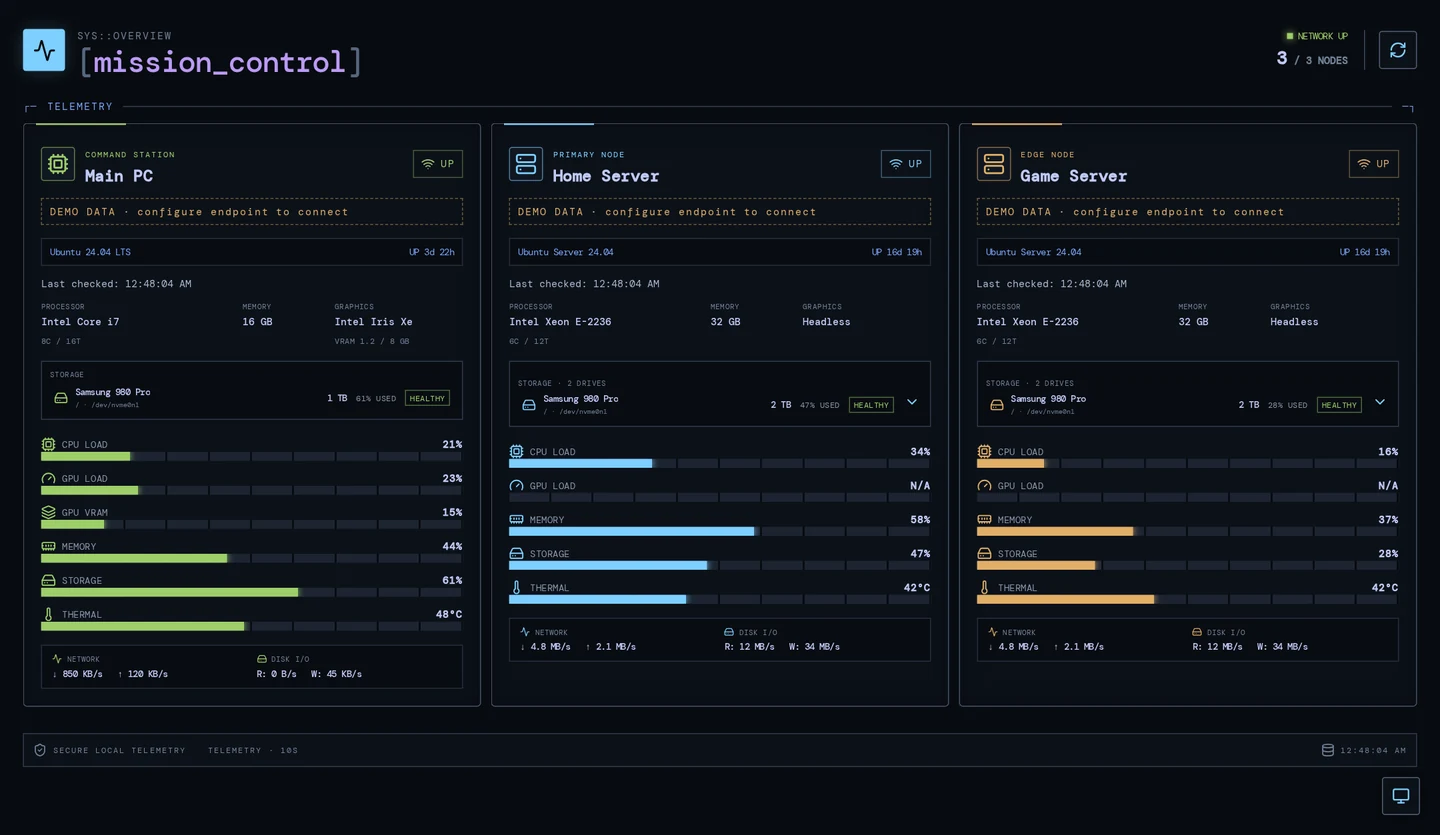
Background server workers poll each host on a shared schedule, so adding browser tabs never multiplies load on monitored machines.
Benchmark harnesses, memory telemetry, and tool-reliability testing for running the Hermes agent on a 16 GB RX 9070 desktop. Raw token speed turned out to be the wrong metric: a slower model beat faster ones inside the real agent loop because it finished in fewer steps and stopped when the job was done.
Current status (November 26, 2026): standalone Ollama was retired on November 24, local PolyStrata HIP inference with Ornith 1.5 35B is paused, and daily Hermes runs on hosted inference while SearXNG, Crawl4AI, and Mnemosyne (local Qdrant) run locally. Read the Local AI Infrastructure case study for full benchmark tables and methodology.
I am a junior at Purdue University dual majoring in Network Engineering Technology and Cybersecurity, graduating in May 2028.
The fastest way for me to understand a system is to run it myself, break it on a real machine, and trace what actually happened. Reading documentation helps, but watching a container fail health checks, tracking down memory pressure after a RAM stick dies, or seeing an agent loop on a bad tool call teaches things a textbook skips.
Everything on this site is built around hardware I maintain and documented in public with sanitized configurations, test suites, and notes on what worked and what did not.